After manufacturing air filters for over a decade and serving more than two million households, we've seen this pattern play out consistently. The filter you choose and when you swap it out are two of the most direct variables in your monthly HVAC operating cost, and making the right choice can support better airflow, steadier system performance, and greater day-to-day efficiency with a 16x20x1 HVAC home air filter.
TL;DR Quick Answers
16x20x1 HVAC Home Air Filter
The 16x20x1 is one of the most common residential HVAC filter sizes in the U.S. Here's what you need to know before you buy:
Nominal vs. actual size. The 16x20x1 designation is a rounded nominal size. Actual dimensions are typically 15.5 × 19.5 × 0.75 inches. Measure your slot opening before ordering.
MERV options. MERV 8 (Standard) suits most homes. MERV 11 (Superior) adds capture efficiency for pet dander and finer particles. MERV 13 (Optimal) is appropriate for households with respiratory sensitivities — provided the system's blower supports the higher resistance.
Replacement schedule. Every 30 days for homes with pets, allergy sufferers, or systems running near-continuously. Every 60 to 90 days for average households.
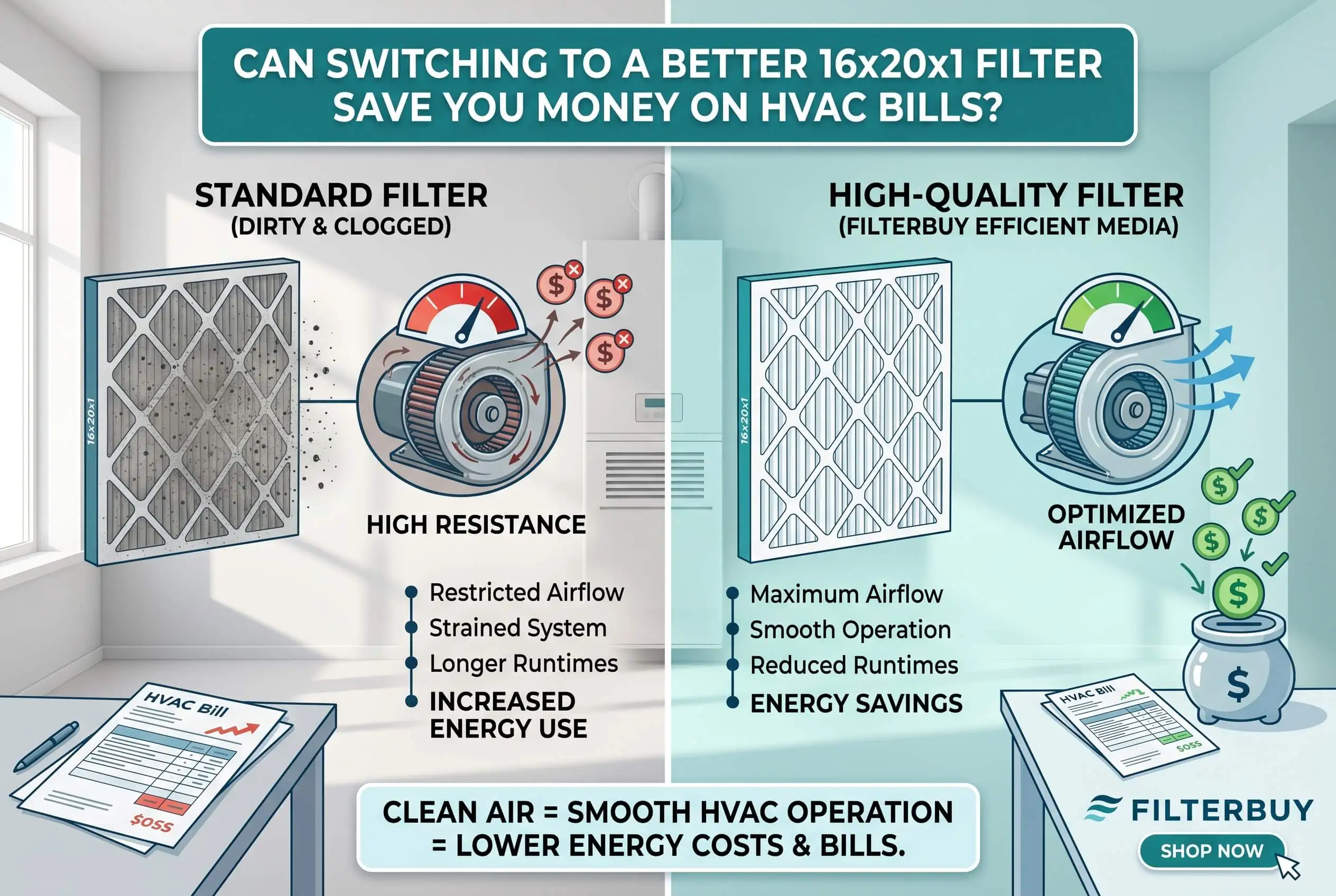
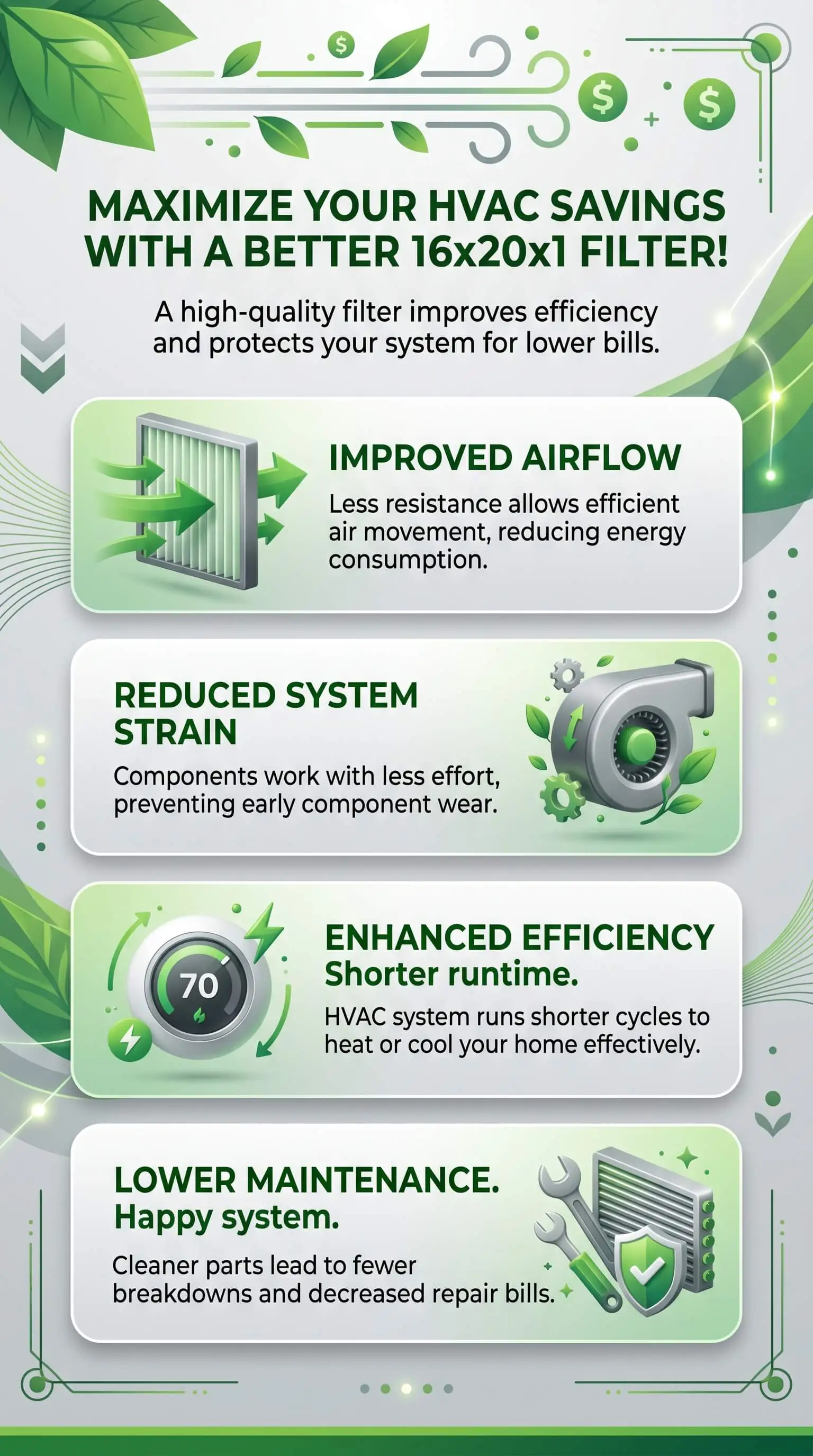
Energy impact. A correctly rated 16x20x1 filter keeps static pressure within your blower motor's design range. A saturated or mismatched filter forces longer run cycles and higher energy draw.
Frame matters. A fully sealed frame is as important as media quality. Gaps at the edges let unfiltered air bypass the media entirely.
Top Takeaways
A 16x20x1 HVAC home air filter with a MERV rating that exceeds your blower motor's design capacity creates elevated static pressure, forcing longer run cycles and higher energy draw with every heating or cooling call.
Space heating and air conditioning account for 52% of the average U.S. household's annual energy consumption, making the system your filter serves the single largest energy cost in your home.
MERV 8 is the correct starting point for most standard residential HVAC systems — effective particle capture without meaningful airflow restriction. Move to MERV 11 for pets or mild allergies. Move to MERV 13 only if your system's blower capacity supports it.
Replacing a 16x20x1 filter on schedule — every 30 days for heavy-use homes, every 60 to 90 days for average households — prevents the saturation that quietly increases energy costs between billing cycles.
A neglected filter doesn't only hurt efficiency. Sustained airflow restriction can overheat the heat exchanger and freeze the evaporator coil, both of which require expensive service to correct.
The 16x20x1 nominal size has actual dimensions of approximately 15.5 × 19.5 × 0.75 inches. Measure your slot opening before ordering rather than relying on the size printed on the existing filter frame.
Edge sealing matters as much as media quality. A filter with gaps at the frame lets unfiltered air bypass the media entirely, negating both the filtration value and the efficiency benefit.
How Your 16x20x1 Filter Choice Affects What You Pay to Heat and Cool
How a 16x20x1 Filter Affects HVAC Energy Use
Every residential HVAC system is built to move air through a specific resistance range. Engineers call that resistance static pressure, and it's the force the blower motor works against on every cycle. A new, correctly rated filter keeps that resistance low. A filter loaded with months of captured debris raises it substantially.
Think of it like breathing through a straw that keeps getting narrower. The blower doesn't ease off — it pushes harder, draws more electricity, and runs longer cycles trying to reach the thermostat setpoint. The energy penalty compounds with every degree of additional restriction. That filter looks passive. In practice, it's one of the most active cost variables in your home and one of the most important components for improving home air quality.
What MERV Rating Is Best for a 16x20x1 HVAC Home Air Filter?
MERV, or Minimum Efficiency Reporting Value, is the industry-standard scale defined under ANSI/ASHRAE Standard 52.2. It measures how effectively a filter captures particles across a range of sizes. Higher MERV means finer filtration and tighter media, which also raises resistance to airflow.
Filterbuy manufactures 16x20x1 filters across three residential MERV tiers. MERV 8 (Standard) captures dust, pollen, mold spores, and larger debris. It's the right match for most standard residential HVAC systems, delivering effective filtration with minimal pressure drop. MERV 11 (Superior) adds capture efficiency for finer particulates, including pet dander and some smoke particles, making it the better choice for homes with pets or mild allergy sensitivities. MERV 13 (Optimal) reaches into the submicron range — bacteria, virus carriers, fine combustion particles — and is appropriate for households where a family member has respiratory sensitivities or a diagnosed lung condition.
The right MERV is the one matched to your system's blower capacity. A filter rated higher than the blower can accommodate restricted airflow beyond the design envelope, increasing energy use instead of reducing it. Browse the full range of 16x20x1 HVAC home air filters in MERV 8, 11, and 13 to find the right fit for your system.
How Often Should You Change a 16x20x1 HVAC Home Air Filter?
Replacement frequency is an energy variable most homeowners don't connect to cost. A saturated filter restricts airflow more than a fresh one, and a filter that's six weeks past due costs money every day it stays in the slot.
Every 30 days is the right interval for heavy-use households: homes with pets, allergy sufferers, or systems running near-continuously through long heating or cooling seasons. Every 60 to 90 days covers average households with moderate seasonal use. Not sure where you fall? Pull the filter and hold it up to a light. If you can't see through it, it's past due, no matter what the calendar says.
Can a Dirty 16x20x1 Filter Damage Your HVAC System Over Time?
Yes, and the damage arrives in two specific ways that carry expensive repair bills.
The first is heat exchanger overheating. When airflow is restricted, heat builds up in the heat exchanger rather than transferring into the air stream. Sustained overheating accelerates metal fatigue, cracks the exchanger surface, and can allow combustion byproducts into the living space.
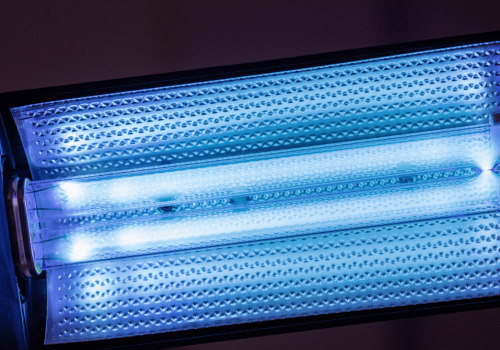
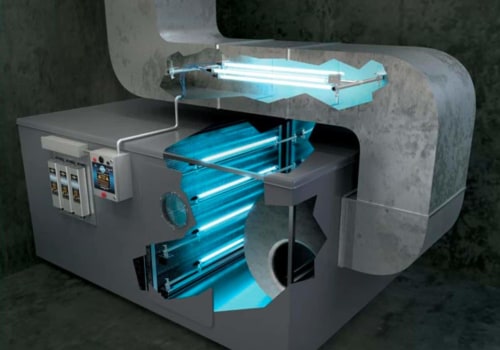
The second is evaporator coil freeze. Without adequate airflow across the coil, refrigerant drops below the freezing point of the moisture it normally absorbs. The coil ices over and cooling stops, usually followed by a defrost cycle or a service call. Both failures trace back to the same problem — a neglected or mismatched filter cutting off the airflow the system needs, even in systems that use UV lights in HVAC systems. A $10 to $20 replacement filter is the cheapest maintenance item in the system. By a wide margin.
What to Look for When Buying a 16x20x1 HVAC Home Air Filter
The 16x20x1 is a nominal size, a rounded reference number used across the industry. Actual filter dimensions are typically 15.5 × 19.5 × 0.75 inches. Before ordering, measure the slot opening in your air handler or wall return grille rather than relying on what's printed on the existing filter frame. Dimensions can vary slightly between manufacturers.
Beyond dimensions, media quality and frame construction matter. Look for filters with a consistent, fully sealed cardboard or beverage board frame. Gaps at the edges let unfiltered air bypass the media entirely, which defeats both the filtration and the efficiency purpose. Pleat count and media density affect capture efficiency and pressure drop in equal measure. Filterbuy manufactures all filters in the U.S. with quality-controlled media and frame construction, shipped direct from our production facility to your door.
"We track filter performance all the way through production, and one pattern holds true across every MERV tier: the physical restriction a filter creates is set by its media density, not the marketing on the box. A 16x20x1 at MERV 13 has meaningfully higher initial resistance than a MERV 8 in the same size, and in a system where the blower wasn't spec'd for that load, you'll see it in longer run times and higher draw almost immediately. That's why matching MERV to your system matters as much as the filtration number itself."
7 Essential Resources
Seven sources from federal agencies and industry standard-setters cover the research behind every recommendation on this page, from MERV ratings to indoor air quality data.
Why Space Heating and Cooling Dominate Your Home's Energy Footprint
The U.S. Energy Information Administration's breakdown of residential energy use shows that space heating and air conditioning together consume more than half of a typical household's annual energy — 52% as of 2020. Understanding where the energy goes is the first step toward knowing where filter performance moves the needle on your bill.
Source: https://www.eia.gov/energyexplained/use-of-energy/homes.php
What the U.S. Department of Energy Says About Filter Maintenance and System Efficiency
The DOE's Air Conditioner Maintenance guidance explains how dirty, clogged filters reduce airflow and force HVAC systems to work harder, creating a performance decline that raises energy use. It also covers how a neglected filter allows dirt to bypass the media and accumulate on the evaporator coil, reducing the coil's heat-absorbing capacity over time.
Source: https://www.energy.gov/energysaver/maintaining-your-air-conditioner
How the MERV Scale Measures Filter Efficiency — the ASHRAE Standard Explained
MERV ratings are defined and tested under ANSI/ASHRAE Standard 52.2, the industry standard for measuring how efficiently a filter removes particles across size ranges from 0.3 to 10 microns. Understanding what the MERV scale measures, and how pressure drop increases with each rating, is essential for selecting the right filter without over-restricting your system.
Source: https://www.ashrae.org/technical-resources/standards-and-guidelines
The EPA's Indoor Air Quality Data: Why What Circulates Through Your Filter Matters More Than You Think
The EPA reports that Americans spend approximately 90% of their time indoors, where concentrations of some pollutants are often 2 to 5 times higher than outdoor levels. The particles your HVAC filter captures, or fails to capture, directly affect the air quality your family lives in every day.
Source: https://www.epa.gov/report-environment/indoor-air-quality
A Homeowner's Complete Guide to Indoor Air Pollution Sources and Controls
The EPA's Inside Story guide covers the primary sources of indoor air pollution, explains how ventilation affects pollutant concentrations, and provides practical source-control guidance. Homeowners who want to understand why consistent HVAC filter maintenance is a front-line defense against particle accumulation will find this a useful companion to the filter selection process.
Source: https://www.epa.gov/indoor-air-quality-iaq/inside-story-guide-indoor-air-quality
ENERGY STAR's Heating and Cooling Efficiency Resources for Homeowners
ENERGY STAR's heating and cooling resource hub covers how airflow restrictions from clogged or overly restrictive filters reduce HVAC system efficiency, how to evaluate equipment performance, and where home energy use can be reduced through maintenance and proper filtration. A practical companion to filter selection decisions.
Source: https://www.energystar.gov/products/heating_cooling
What You're Actually Breathing: The EPA's Volatile Organic Compound Exposure Research
The EPA's VOC research documents that concentrations of many organic pollutants are consistently higher indoors than outdoors — in some cases up to ten times higher. These compounds are not captured by low-efficiency filters, which reinforces why MERV rating selection is both an energy decision and a health decision for your household.
Source: https://www.epa.gov/indoor-air-quality-iaq/volatile-organic-compounds-impact-indoor-air-quality
These seven resources explain how a top air filter supports better HVAC efficiency, proper airflow, informed MERV selection, and cleaner indoor air based on guidance from federal agencies and industry standards.
3 Supporting Statistics
Each figure below comes from a U.S. government source and was verified live before publication.
Space heating and air conditioning account for 52% of the average U.S. household's annual energy consumption. That figure comes from the EIA's 2020 Residential Energy Consumption Survey. It means more than half of every energy dollar a typical American household spends goes directly into heating and cooling. A 16x20x1 HVAC home air filter feeds that system. When the filter restricts airflow, the efficiency of your household's biggest energy draw declines, and the bill reflects it.
Source: https://www.eia.gov/energyexplained/use-of-energy/homes.php
Replacing a dirty air conditioner filter is one of the most direct maintenance actions for system efficiency, according to the U.S. Department of Energy. The DOE's Air Conditioner Maintenance guidance states that dirty, clogged filters reduce airflow and system efficiency, and that when airflow is obstructed, dirt can bypass the filter and accumulate on the evaporator coil, reducing its heat-absorbing capacity. A neglected 16x20x1 filter doesn't just strain the blower motor. It degrades the coil's ability to do its job, compounding the energy penalty over time.
Source: https://www.energy.gov/energysaver/maintaining-your-air-conditioner
Americans spend approximately 90% of their time indoors, where concentrations of some pollutants are often 2 to 5 times higher than typical outdoor concentrations — according to the EPA. This figure reframes what a filter does beyond energy efficiency. Every particle your 16x20x1 HVAC home air filter captures is a particle that doesn't recirculate through the air your family breathes. Matching the right MERV rating to your system isn't only about pressure drop and run time. It also determines how much dust, dander, mold spores, and fine particulates your household breathes daily.
Source: https://www.epa.gov/report-environment/indoor-air-quality
Final Thoughts and Opinion
The filter slot in a residential HVAC system is one of the few places where a small, inexpensive decision has a direct and measurable effect on a major household cost. A 16x20x1 HVAC home air filter in the wrong MERV tier, or one that's been in place two months past its useful life, is not a neutral variable. It costs money on every cycle the blower runs.
Most homeowners treat energy bills as fixed costs, the way they treat weather. They're not. The equipment doing the heating and cooling in your home responds directly to how well it can breathe. We've watched this play out across millions of installations, and the pattern holds: a filter that fits right, carries the right MERV for the system, and gets swapped on schedule is one of the highest-return maintenance habits a homeowner can build. The filter you can't see is doing more than you think.
Frequently Asked Questions
Q: Can switching to a better 16x20x1 HVAC home air filter really lower my energy bill?
A: Yes, in two distinct ways. A correctly rated filter maintains the airflow your blower motor was designed for, which keeps run times shorter and energy draw lower per cycle. Consistent replacement then prevents the saturation that increases resistance over time.
A filter matched to your system's MERV tolerance doesn't force the blower to compensate.
A fresh filter reduces the static pressure load, directly shortening run cycles and reducing the electricity needed to reach setpoint.
Q: What MERV rating is best for a 16x20x1 filter without hurting HVAC efficiency?
A: MERV 8 is the right choice for most standard residential systems. It captures dust, pollen, mold spores, and household debris without restricting airflow beyond design parameters.
MERV 8 (Standard): appropriate for most homes with standard HVAC blowers.
MERV 11 (Superior): recommended for homes with pets or mild allergy sufferers.
MERV 13 (Optimal): appropriate for households with respiratory sensitivities, provided the system's blower can handle the additional resistance.
Q: How often should I change my 16x20x1 air filter to keep energy costs down?
A: Replace every 30 days if your system runs heavily, you have pets, or someone in the home has allergies or respiratory conditions. For average households, every 60 to 90 days is appropriate.
Heavy use, pets, or allergies: replace at 30 days.
Average household, moderate seasonal use: replace every 60 to 90 days.
When in doubt, hold the filter up to a light source. If you can't see light through the media, it's past due regardless of how long it's been installed.
Q: What happens to my HVAC system if I leave a dirty 16x20x1 filter in too long?
A: A saturated filter restricts airflow to a degree the system wasn't designed to handle. Two expensive failure modes can follow, and both are preventable with a timely filter swap.
Heat exchanger overheating: restricted airflow traps heat in the exchanger rather than transferring it into the air stream. Sustained overheating accelerates metal fatigue and can crack the heat exchanger.
Evaporator coil freeze: insufficient airflow across the coil causes refrigerant to drop below freezing. The coil ices over, the system loses cooling capacity, and a defrost cycle or service call follows.
Q: Is a thicker filter always better for energy savings than a standard 1-inch 16x20x1?
A: Not automatically. Thicker filters (2, 4, or 5 inches) generally offer lower initial resistance and longer service life because the media has more surface area to distribute captured particle load. But they require a compatible filter slot and may need a specific media cabinet, so compatibility comes first.
A 1-inch 16x20x1 filter in the right MERV rating, changed on schedule, performs effectively in systems designed for that profile.
Never force a thicker filter into a slot designed for 1-inch filters. Frame compression creates bypass gaps that let unfiltered air past the media entirely.
Q: What are the actual dimensions of a 16x20x1 air filter?
A: The 16x20x1 designation is a nominal size, a rounded reference number used across the industry. Actual dimensions are typically 15.5 × 19.5 × 0.75 inches. Measure your filter slot opening before ordering, particularly if switching brands, because actual dimensions can vary slightly between manufacturers.
Q: Does a higher MERV rating cause my HVAC system to use more energy?
A: A higher MERV filter creates more resistance to airflow than a lower MERV filter of the same nominal size. Whether that translates to higher energy use depends on how the increased resistance compares to your system's design specifications.
In a system rated for MERV 13, a MERV 13 filter operates within design parameters and doesn't meaningfully increase energy draw.
In a system designed for MERV 8, installing a MERV 13 filter forces the blower outside its efficient operating range — which does increase energy consumption.
Match MERV to system capacity, not to the highest available rating.
Q: How do I know when my 16x20x1 HVAC filter needs to be replaced?
A: Several indicators signal a filter is past due, even before the scheduled replacement date.
Visual check: hold the filter up to a light source. If you can't see light through the media, it's saturated.
System behavior: longer run cycles to reach the thermostat setpoint, weaker airflow from supply registers, or unusual blower noise can all indicate filter restriction.
Dust accumulation: visible dust on supply registers or return grilles near the filter slot can signal that particles are beginning to bypass a saturated filter.
Schedule: if you can't remember when you last changed it, change it now and set a recurring reminder.
Take the Next Step
Your HVAC system runs more efficiently when the filter in front of it is correctly rated and fresh. Browse Filterbuy's full lineup of 16x20x1 air filters in MERV 8, 11, and 13, manufactured in the U.S. and shipped direct from our production facility. Pick the right level of protection for your system and set a replacement reminder while you're at it.