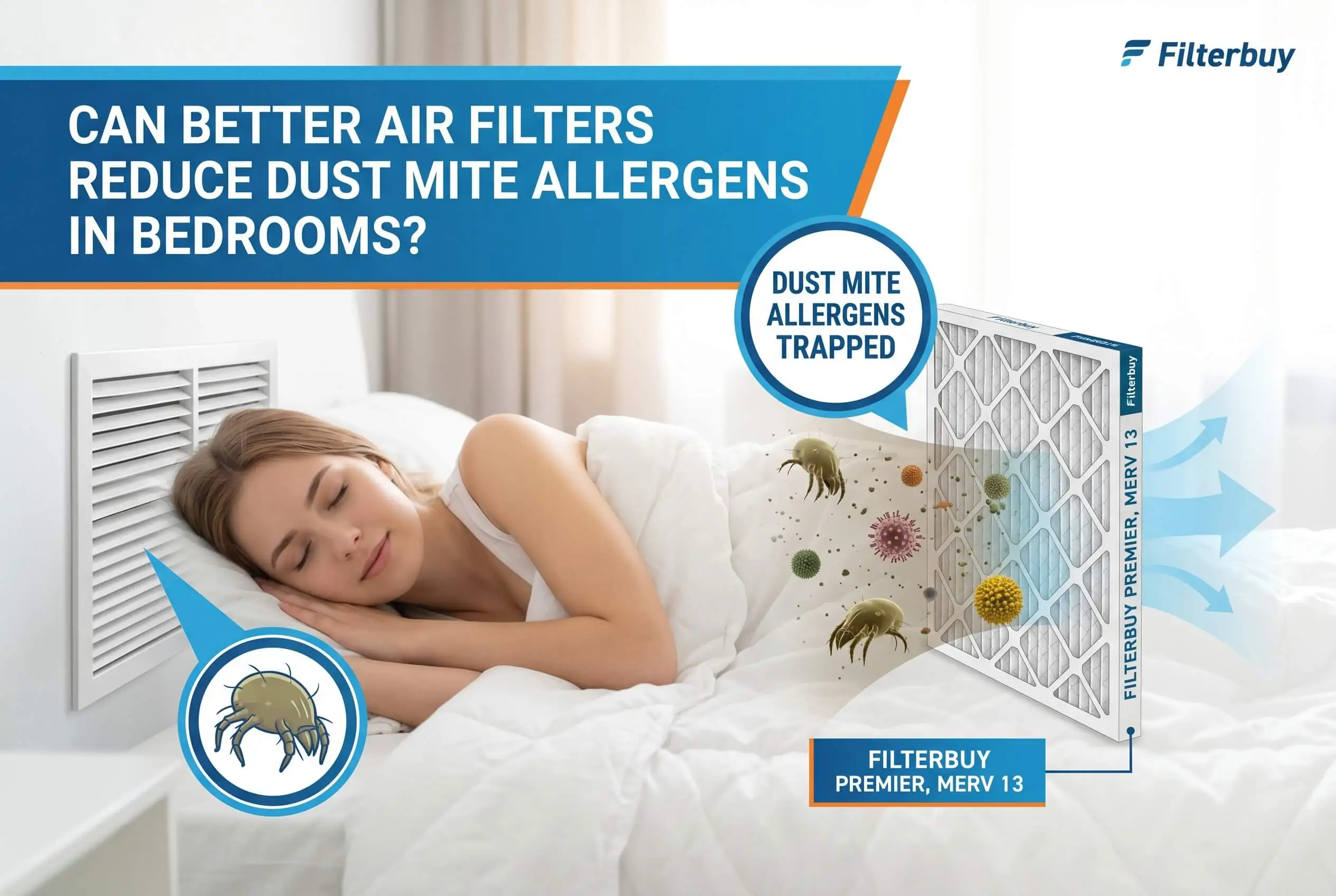
Most homes house more dust mites than the people who live there will ever know, with hundreds of thousands in the average bed alone. The allergens these mites leave behind, fecal pellets and body fragments small enough to ride a household airflow, are invisible to the eye but heavy in the bedroom air every night. We've found this is where a better air filter does some of its quietest, most useful work.
So can the right air filter actually reduce the dust mite allergens in a bedroom? In our experience, yes, with a few honest caveats. Higher-efficiency filters pull a meaningful share of those airborne fragments out of the air before they reach your breathing zone, and this is one of the most underused moves we see in household allergen control. Filtration earns its keep as part of a layered plan that includes humidity control, mattress encasements, and a regular bedding wash — not as a standalone fix.
TL;DR Quick Answers
air filters
Air filters are pleated screens installed in HVAC systems and portable cleaners to pull airborne particles out of the air you breathe. We've found the rating matters more than the brand: MERV 11 to 13 handles common indoor allergens like dust mite fragments, pet dander, and pollen, while HEPA tackles the smallest particles.
What they catch: dust, pollen, pet dander, mold spores, smoke, dust mite fragments, and a portion of bacteria and viruses depending on the rating.
How they're rated: the MERV scale runs 1 to 16 for typical residential systems, and HEPA media carry MERV-equivalent ratings of 17 to 20, trapping at least 99.97% of particles at 0.3 microns.
When to replace: every 60 to 90 days for high-MERV filters in homes with pets, carpet, or allergy concerns, and longer windows for lower-MERV filters in tighter homes.
Top Takeaways
Bedrooms are dust mite headquarters because they combine three conditions in one room: warm overnight humidity, the skin cells you shed while sleeping, and dense fabric habitat.
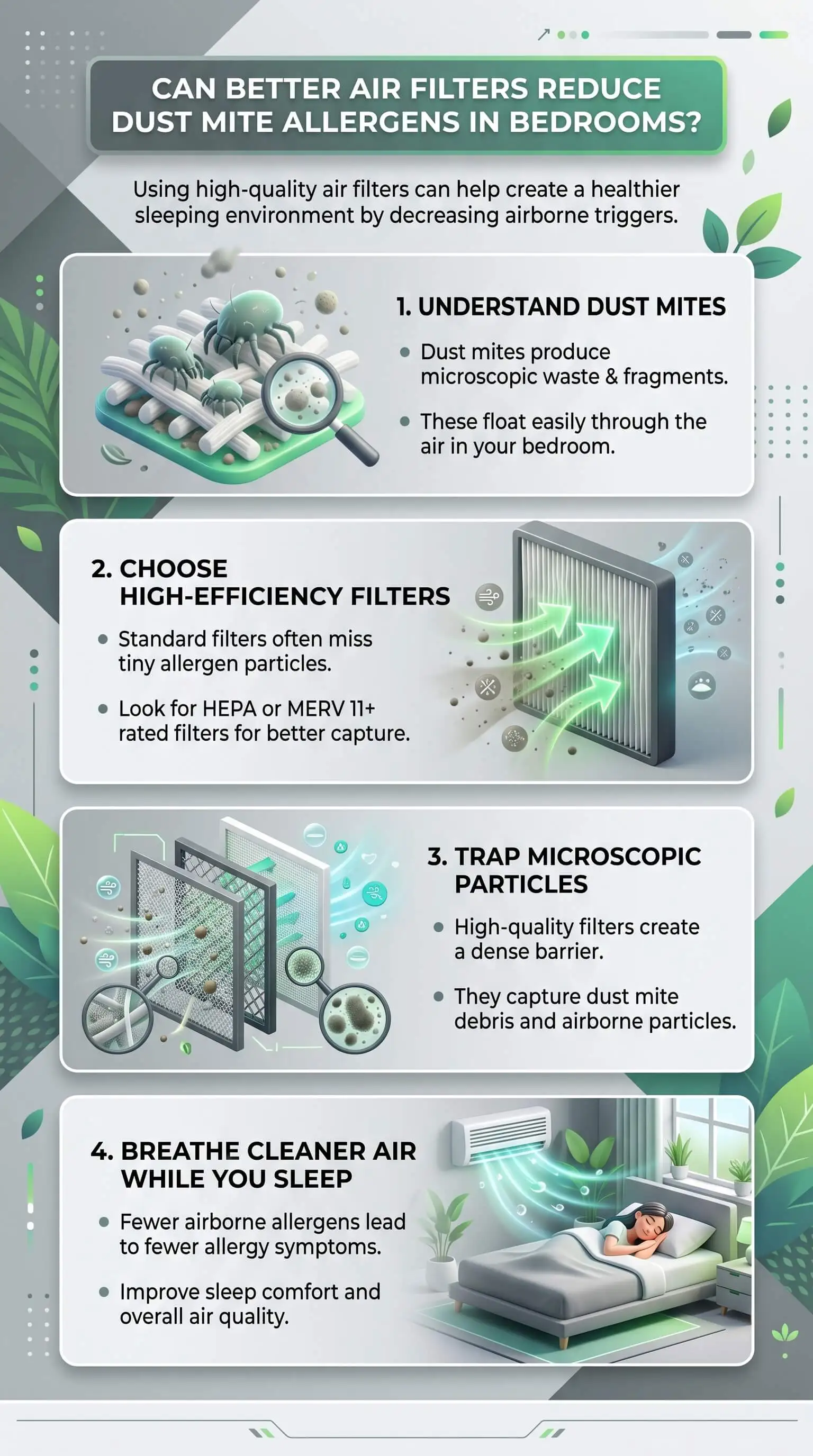
The actual allergens are dust mite fecal pellets and body fragments, not the mites themselves, and they become airborne every time someone shakes out bedding or walks across carpet.
MERV 11 filters start catching the smaller airborne fragments. MERV 13 captures at least 50% of the smallest tested particles per EPA guidance.
Whole-home HVAC filtration and portable HEPA cleaners deliver the strongest results when they're layered together, not chosen between.
Filtration is one layer of a plan that also needs humidity control under 50%, mattress encasements, and regular bedding washes.
Why Dust Mite Allergens Concentrate in the Bedroom
The bedroom gives dust mites every condition they need in one place. Body heat and overnight breath keep relative humidity higher than anywhere else in the house, the skin cells you shed while sleeping provide a steady food supply, and the dense fabric environment of mattress, pillows, comforter, carpet, and upholstered headboard gives them more habitat than any other room can offer.
The American Lung Association points out that dust mite allergens don't stay airborne long once they're disturbed. They settle quickly into fabrics. What you're actually reacting to isn't the mites themselves but their fecal pellets and broken-down body fragments, which lift back into the air every time you shake out a comforter, turn a mattress, or walk across carpet. That's how a home can be allergen-heavy without anyone ever spotting a single mite.
EPA classifies dust mites among the leading indoor asthma triggers and recommends keeping bedroom relative humidity between 30% and 50% to keep their numbers in check. Homes in humid climates or with poor bedroom ventilation tend to run wetter air overnight, and that wet air feeds bigger mite colonies and a heavier daily allergen load.
What Air Filters Actually Capture (and What They Miss)
Most residential air filters carry a MERV rating, short for Minimum Efficiency Reporting Value, that runs from 1 to 16 for typical home systems and tracks how well a filter catches particles across three size ranges: 0.3 to 1 micron, 1 to 3 microns, and 3 to 10 microns. The Wikipedia overview of air filters explains it in more detail. The higher the rating, the smaller the particles a filter pulls out of the air passing through it.
Dust mite allergens fall across that spectrum at different sizes. The settled allergen particles in carpets and bedding are usually 10 to 40 microns, large enough for almost any filter to grab once they reach the airstream. The harder targets are the smaller airborne fragments kicked up by daily movement. They land in the 3 to 10 micron range and below, which is where MERV rating starts to matter for an allergy-sensitive household.
A MERV 8 filter handles the larger pieces of debris, MERV 11 starts pulling out the smaller airborne portion, and per EPA's Guide to Air Cleaners in the Home, filters rated MERV 13 and above are required to capture at least 50% of the smallest particles tested.
One limit is worth saying plainly. An air filter only works on the air that actually moves through it. Allergens that have already settled into a mattress or pillow stay put until something mechanical removes them, which is why vacuuming, hot-water washing, and mattress encasements stay part of any honest dust mite plan.
HEPA vs. High-MERV HVAC Filters for Bedrooms
Households often ask us which way to go: a higher-MERV HVAC filter or a portable HEPA cleaner in the bedroom. Our honest answer is that the two solve slightly different problems, and the strongest results almost always come from running both.
A high-MERV HVAC filter, usually a MERV 11 to 13 in residential systems, catches particles in every cubic foot of air that moves through the central system. The whole house gets the benefit, and once the filter is in, the per-month cost stays modest. The tradeoff is compatibility. Not every furnace or air handler can push air through a higher MERV rating without straining the blower motor or losing overall airflow, so EPA recommends checking with an HVAC pro or your manufacturer specs before jumping to a MERV 13 in an older system.
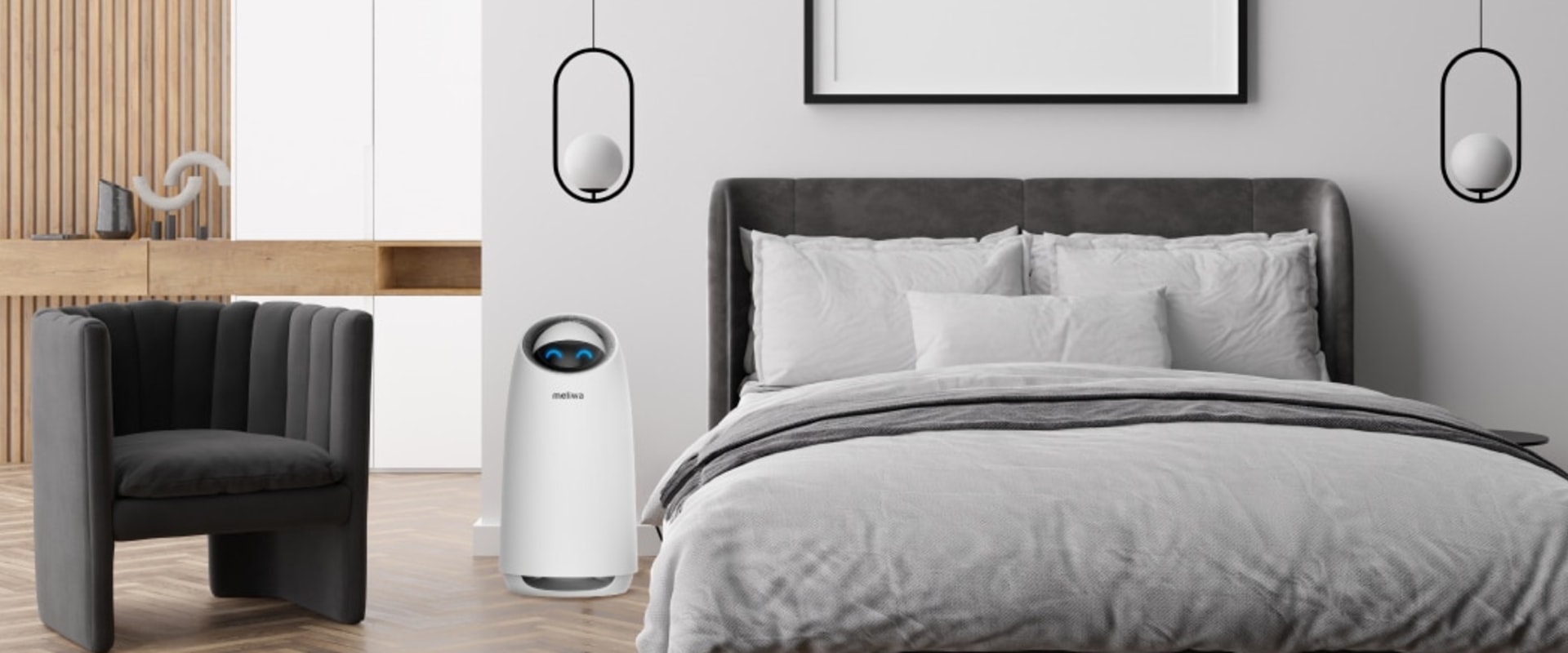
A portable HEPA cleaner placed in the bedroom takes a different approach. EPA's definition of HEPA covers media that carry MERV-equivalent ratings of 17 to 20 and trap at least 99.97% of particles at 0.3 microns, which is small enough to grab even the trickier dust mite fragments. The unit concentrates that filtration in the room where most of your sleep-time exposure actually happens, runs continuously, and doesn't depend on your HVAC system for any of its work. The tradeoff is cost — per unit, per room, rather than spread across the whole house.
In our experience, the households that report the clearest symptom relief use both. A high-MERV HVAC filter handles the whole-home baseline. A HEPA cleaner sized for the bedroom's square footage handles the room where it counts most while you sleep.
Choosing the Right Air Filter for a Bedroom Allergen Problem
Sizing up a filter upgrade for an allergen-sensitive bedroom usually comes down to three honest questions: what MERV rating your system can actually handle, how thick a filter the cabinet will accept, and how reliably you replace it once it's in.
Start with the MERV rating. Most modern residential systems comfortably handle MERV 11 to 13, while older ones often top out at MERV 8 or 10 without modification. Your system manual or an HVAC tech can confirm the ceiling in a few minutes, and that single check heads off the most common upgrade mistake we see: installing a filter so restrictive the blower can't push air through it.
Then think about thickness. A deeper pleated filter, where your cabinet has room for a 4-inch or 5-inch option, carries far more pleated surface area than a 1-inch filter at the same MERV rating. You get less airflow resistance, longer service life, and a more forgiving system overall. Households running high-MERV filtration in a 1-inch slot tend to see pressure-drop buildup faster, which puts them back in the replacement aisle sooner than they expected.
Last comes the replacement habit. For allergen-focused households, we generally suggest swapping high-MERV filters every 60 to 90 days, and sooner in homes with pets, carpet, or open windows during pollen season. A loaded filter quietly loses efficiency on the very particles you chose it to catch in the first place. Sourcing high-MERV residential air filters in the right size for your system makes that 60-to-90-day habit easy to stick to, and a habit that actually sticks is what keeps the rating doing its job.
"What we see consistently across allergen-focused households is that the filter rating only does what it's meant to do when paired with a realistic replacement cadence. The bedrooms that go from problem rooms to peaceful rooms are usually the ones where the homeowner pairs a MERV 11 or 13 setup with a 60-day replacement habit and weekly bedding washes."
7 Essential Resources
Primary-source references readers can use to build out a fuller bedroom allergen plan.
EPA — Guide to Air Cleaners in the Home: federal overview of MERV ratings, filter performance, and system compatibility.
EPA — Asthma Triggers: Gain Control: federal guidance on dust mites as a leading indoor asthma trigger, with environmental control recommendations.
AAFA — Improving Indoor Air Quality: Asthma and Allergy Foundation of America guidance on humidity, ventilation, and filtration for allergen control.
American Lung Association — Dust Mites: plain-language explainer on dust mite biology, exposure mechanics, and bedroom-specific reduction tactics.
EPA — What Is a HEPA Filter: federal definition of HEPA classification, MERV equivalence, and residential application context.
EPA — Biological Pollutants and Indoor Air Quality: technical overview of dust mites among the biological pollutants that affect respiratory health.
Wikipedia — Air Filter: general overview of filtration technology, classification, and mechanism.
3 Supporting Statistics
Americans spend up to 90% of their time indoors, which makes indoor allergen exposure a meaningful share of total environmental load (source: EPA).
Filters with a MERV rating of 13 and above are required to demonstrate at least 50% removal efficiency for the smallest particles tested (source: EPA Guide to Air Cleaners in the Home).
Indoor relative humidity of 30% to 50% is recommended to reduce dust mite populations and mold growth (source: EPA and AAFA).
Final Thoughts and Opinion
An allergen-friendly bedroom rarely comes down to one fix. The filtration question matters, and a higher-MERV HVAC filter or a HEPA cleaner sized for the room can shift the dust mite allergen load you breathe overnight. Neither device, on its own, cleans bedding, encases a mattress, or holds humidity below 50%.
That's the framing we keep coming back to. Filtration is one of the most useful single moves in a layered approach because it works continuously and quietly while everyone in the house is doing something else. The layering still matters. A MERV 13 filter changed every six months in a humid bedroom with no encasement won't deliver what a MERV 11 filter changed every 60 days in a drier bedroom with washed bedding will.
The bedrooms we've seen go from problem rooms to easy-breathing rooms are usually the ones where the household made three or four moderate changes instead of one big one. Filtration tends to be the easiest place to start, and often the one with the most visible effect on how the room feels by week two or three, especially when paired with other indoor air quality upgrades like incorporating UV lights into HVAC systems.
Frequently Asked Questions
What MERV rating should I use for dust mite allergies?
For most allergy-sensitive households, MERV 11 to 13 is the practical target. MERV 11 starts catching the smaller airborne dust mite fragments, and MERV 13 raises capture efficiency for the smallest particles per EPA guidance. Always confirm your system can handle the rating before you make the swap.
Do air filters help with dust mite allergens, or only airborne pollen?
Air filters help with both, but through different mechanisms. Dust mite allergens settle quickly into bedding and carpet, so HVAC filtration catches them mostly after disturbance, once the fragments are back in the air. Filtration is one layer of dust mite control that works best paired with mattress encasements and humidity management.
Is a HEPA air purifier better than upgrading the HVAC filter?
They solve different problems. A HEPA portable cleaner concentrates filtration in the bedroom where most sleep-time exposure actually happens. A high-MERV HVAC filter handles whole-home circulating air across every room. In our experience, the strongest results come from layering both, not choosing between them.
How often should I replace my air filter if I have allergies?
For high-MERV filters in allergen-sensitive households, 60 to 90 days is the typical replacement window. Pets, carpet, and open windows during pollen season all shorten it. A loaded filter quietly loses efficiency on the very particles you chose it to catch in the first place.
Can a high-MERV air filter damage my HVAC system?
A filter rated higher than the system was designed for can push airflow resistance up enough to strain the blower motor and cut overall airflow. EPA recommends checking your system manual or asking an HVAC technician before upgrading past MERV 8 in older systems. Most modern systems handle MERV 11 to 13 without trouble.
Building a Cleaner Bedroom, One Air Filter at a Time
A better-rated air filter, changed on a realistic cadence, is one of the simplest layers we can add to a bedroom allergen plan. Pair the right MERV rating with mattress encasements, humidity control, and weekly bedding washes, and the room starts quietly working in your favor through every night you sleep in it.